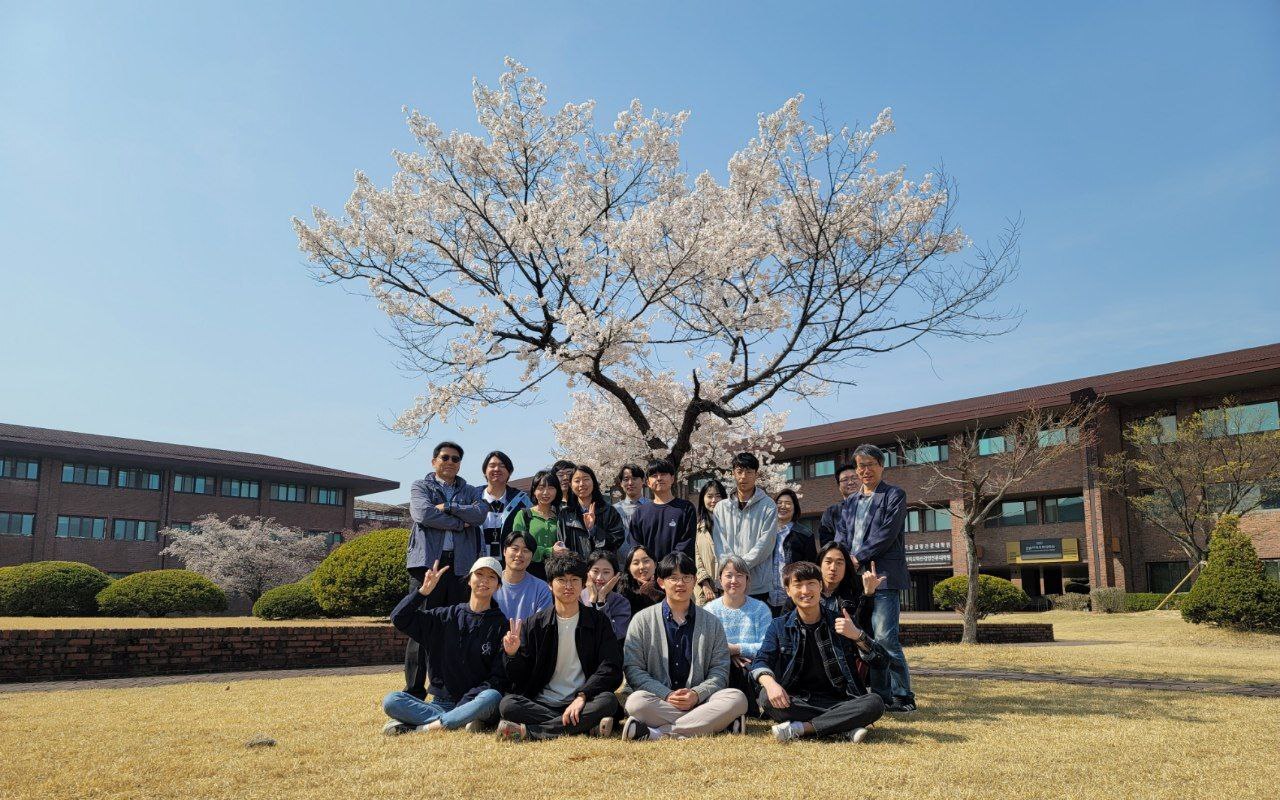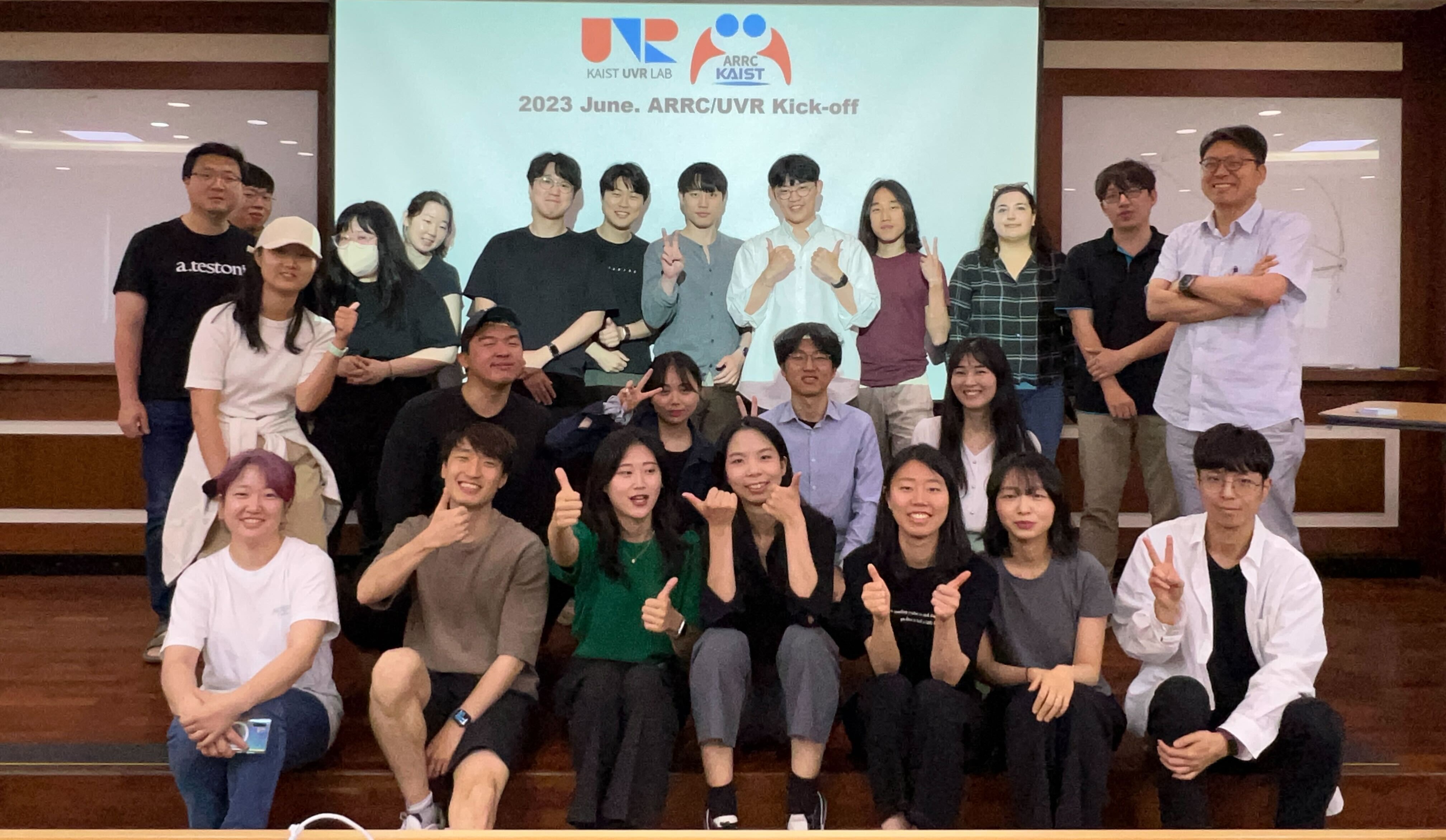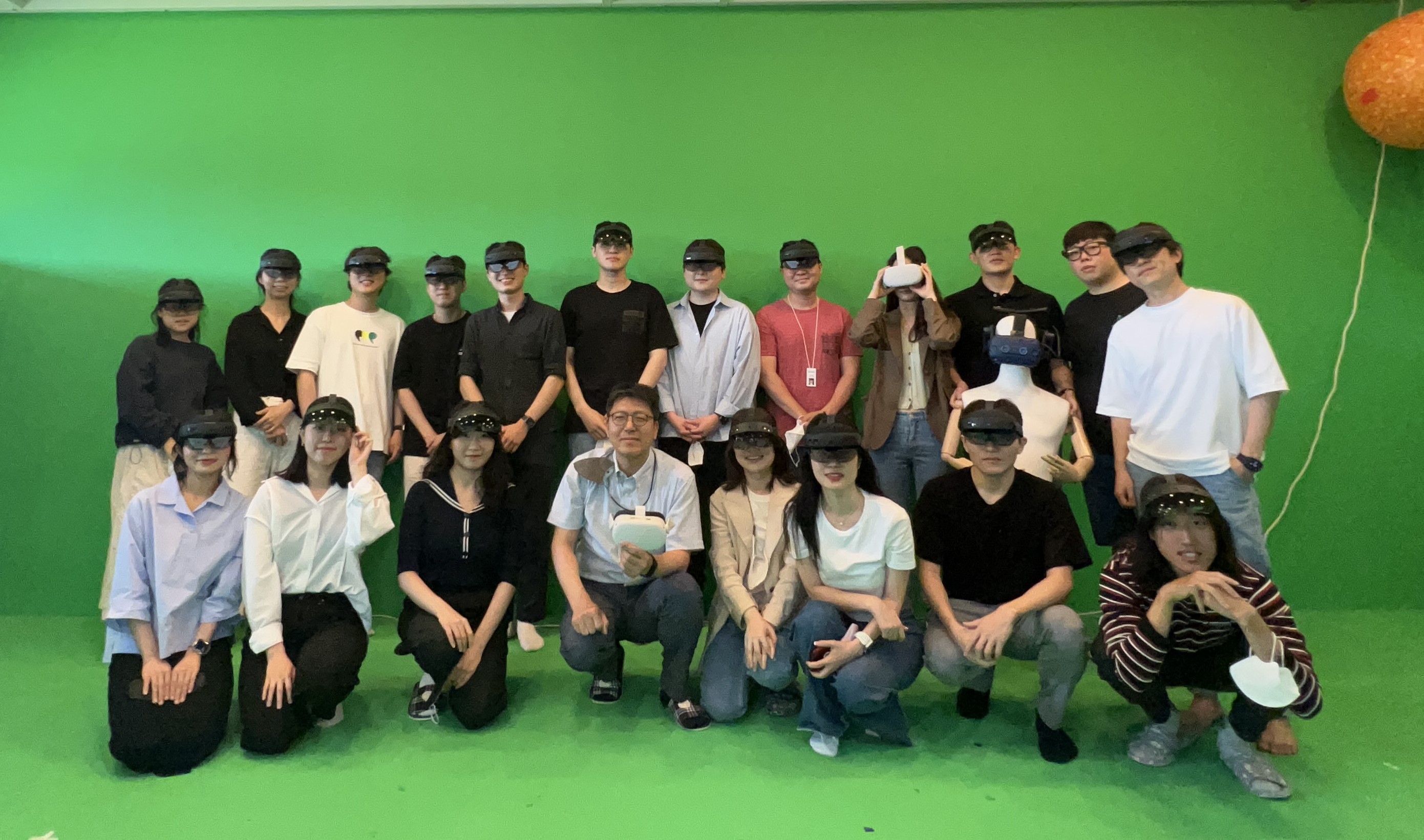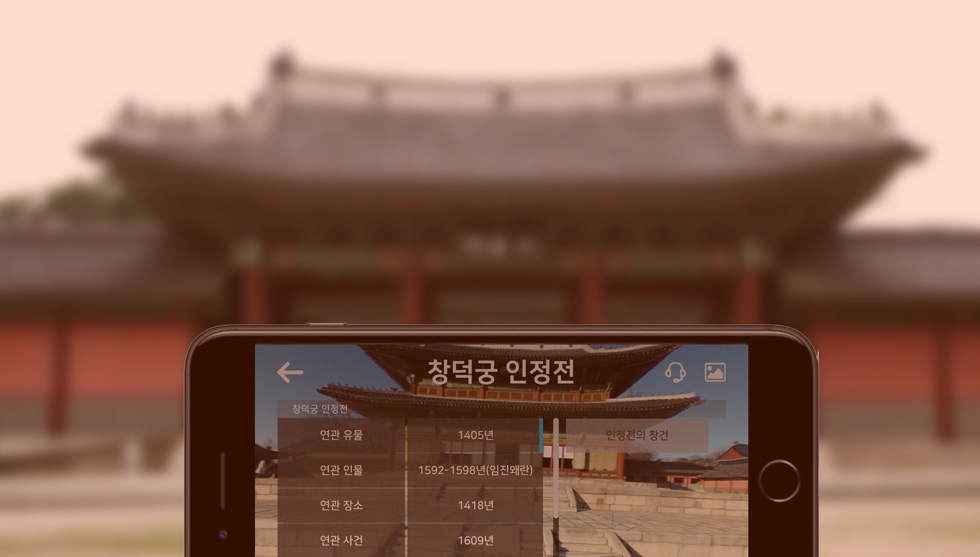
UVR Lab. was formed in Feb. 2001 at GIST to study and develop “Virtual Reality in Smart computing environments” that process multimodal input, perceive user’s intention and emotion, and respond to user’s request through Augmented Reality. Since 2012, UVR Lab moved to KAIST GSCT and restarted with a theme of “FUN in Ubiquitous VR.”
DigiLog Space: Research on Realtime Registration and
Intelligent Information Augmentation for 4D+ Augmented Reality


  • Purpose
    - Final research goal
    - RGB-D feature map for realtime registration of mirror world and intuitive AR
      based information production for intelligent information augmentation.
    - Second year research goal
    - Robust RGB-D feature map to environment changes in indoor for real-time
      generation/update/registration of the dual space and COI based intuitive AR guide information
      for augmentation of intelligent information.
     
  • Contents
    - RGB-D feature map for real-time generation/update/registration of dual space
      in changing lighting condition and textureless indoor environment
    - We design RGB-D based feature map which is robust to lighting changes and textureless
       environment, and registering feature map to static objects in dual space.
    - Production of AR guide information for static COIs based intelligent information augmentation
      in indoor.
    - We define COI-related information extraction/combination model for realtime multiple COI
      objects registration and information visualization with RGB-D feature descriptor.
      Based on this context, we are designing and developing a user-friendly adaptive AR guidance.
     
  • Expected contribution
    - A normal user wearing AR glasses can seamlessly experience COI based intelligent information
      by intuitively authoring/augmenting/interacting with 4D+ mirror world while moving in
      indoor/outdoor. In other words, human's activity can be spatially/temporally extended
      by sharing and experiencing useful mirror world information in the real world.
     
  • Application
    - AR based time/space transcended smart work (remote conference), next generation
      experimental education (Science, Math, Art, History, etc), AR simulation (ecology, environment,
      military, urban planning, architecture, disaster, etc), video based information survey (traffic,
      security, etc), AR medical information, AR entertainment.
     
  • Sponsor
    - This research was supported by NRF/MEST Global Frontier R&D Program on Human-centered
      Interaction for Coexistence (NRF-M1AXA003-2011-0028361).
 
DigiLog Miniature
  • Purpose 
    - We propose a novel miniature exhibition method that enables the static miniature to come
      alive through augmented reality (AR) based on a DigiLog experience. This experience combines
      physical and static analog information from conventional miniatures with virtual and dynamic
      digital information generated by a computer.
     
  • Miniature Alive and Interactive Storytelling
    - Our system has the following technical characteristics and advantages. The 3D reconstructed
      model based a novel camera tracking method that enables robust 3D miniature detection/tracking
      and natural 3D content augmentation without using tracking fiducials. On the other hand,
      this novel interaction method is specifically designed for storytelling in miniatures.
      Interaction such as a turning a page on an e-book is applied to the unfolding AR story of
      the miniature. In addition, personal phones as a manipulation prop enables visitors
      to manipulate AR contents to better understand the exhibition.
     
  • Application
    - As an example of the Miniature Alive technology, we designed and implemented an interactive
      miniature system for the Korean folktale “Asadal and Asahnyo”. Visitors can actively participate
      in the Miniature Alive through various interesting interactions.